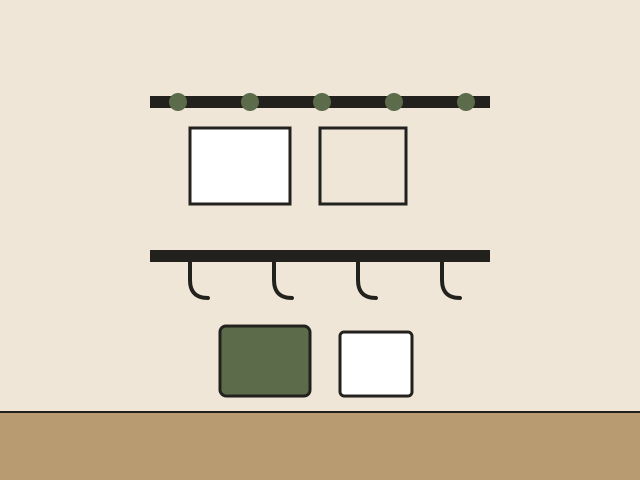
Entryway · 711 mm / 28 in of wall · One afternoon
Why a drop zone earns its wall
A drop zone is the smallest piece of household organisation that actually changes a day. It is one short stretch of wall, close to the door everyone really uses, where coats, bags and the day's paperwork land instead of spreading across a worktop. It is not a mudroom and it does not need to be. The whole point is that it is small enough to keep tidy without thinking about it.
Measure before you decide it will not fit. The wall in the drawing above is 711 mm wide, a little over two feet, which is the width of a lot of awkward stretches between a door frame and a radiator. That is enough for four hooks, a basket underneath and a magnet rail above. If your only candidate is narrower, drop to three hooks and keep the rail; if it is wider, resist filling it, because a drop zone that holds everything stops being a drop zone and becomes a pile.
Setting the heights
Height is the part most people get wrong, and it is the part that decides whether children use the wall or walk past it. An adult coat hook sits comfortably at about 1,700 mm from the floor. A child cannot reach that, so their coat lands on the floor under it and the whole arrangement quietly fails.
Set a second, lower row instead. For a five-year-old, 1,050 mm puts a hook at roughly shoulder height, which is where a bag can be lifted on and off without a stretch. For a three-year-old, come down to 750 mm. Both figures assume the child is standing on the floor rather than on the basket, and both are worth remeasuring once a year, because the reach changes faster than the hardware does.
Mark the heights in pencil, then hold the hook board up and stand back before you drill. A board that is level and 20 mm too low looks intentional. A board that is the right height and 5 mm out of level will bother you every single day.
Hanging the magnet rail
The rail above the hooks is where the day's paper goes: a drawing that came home worth keeping for a week, a form that has to be signed, a reminder about a kit bag. Two magnetic strips give roughly 920 mm of rail, which is enough for three sheets side by side.
Double-sided mounting tape is enough for paper and thin card, and it saves you two more holes in a wall you may want back later. Clean the wall with a dry cloth first, press the strip along its whole length rather than at the ends, and leave it an hour before you hang anything. If you intend to hang anything heavier than paper, use the screws that came with the strip instead; tape is for artwork, not for keys on a heavy fob.
Space the rail about 300 mm above the hook board. Closer than that and a hung coat brushes the paper every time someone passes.
Making it work after the first week
The hardware is the easy half. The habit is the rest of it, and it is built by making each person's job small and specific. Hang the bag on the hook. Take the folder out. Put the lunch box on the counter. Three actions, in the same order, every day, for as long as it takes.
Expect to prompt for a while, and expect it to be uneven between an older child on a fixed school routine and a younger one whose week looks different every day. Add one responsibility at a time rather than the whole list, and only once the previous one has stopped needing a reminder.
Clear the magnet rail on a fixed day. A rail that is three sheets deep is no longer showing anything. Keep one drawing, photograph the rest, and give the wall back its job.