Living room · Any room with one long wall · A weekend
Start from the thing you are not replacing
Colour schemes are usually built the wrong way round, from a paint chart towards a room. Start instead from the largest thing you are not going to replace: the sofa, the floor, a rug that was expensive, a fireplace you cannot move. Everything else has to agree with it, so it may as well lead.
Name the colour honestly. A sofa described as grey is often a warm mushroom, and a scheme built on the word grey will fight it for years. Hold a plain white sheet of paper against it in daylight; whatever the fabric looks like next to true white is what it actually is.
Three depths, one family
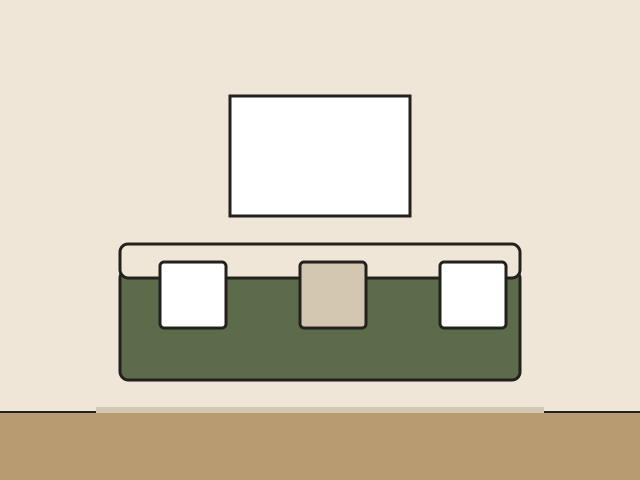
The simplest arrangement that still looks considered is one colour at three depths. A deep version on the largest soft object, a middle version on the textiles that move around, and a pale version on the walls and the floor covering. The drawing above does exactly this with an olive: deep on the sofa, middle on one cushion, pale across the floor.
Keeping to one family is what makes a room with children in it survive. Cushions migrate, blankets end up in other rooms, and a chair gets dragged round for a game. If everything belongs to the same family, none of that reads as mess.
Leave the walls as the quiet part unless you have a specific reason not to. A pale wall lets the layers show; a wall painted the deep version puts all the interest in the one surface you cannot rearrange.
Testing paint the slow way
Paint two coats of each candidate onto a large piece of card, not onto the wall. Card can be moved to the darkest corner, propped against the sofa, and looked at in the evening under the lamps you actually use, which is when most of this room is seen.
Which way the room faces changes everything. A colour in a north-facing room reads cooler and greyer through the day; the same colour on a south-facing wall warms up and can turn noticeably yellow by late afternoon. Nothing about this is a fault in the paint, and no photograph will tell you about it.
Give each candidate two full days before deciding. The colour you like on the first evening is often the one you stop noticing, and the one you were unsure about is often the one that lets the room settle.
Knowing where to stop
The most common mistake in a layered room is one accent too many. Each addition is reasonable on its own, and together they cancel out. If a room has stopped feeling restful, take three things out and live with the gap for a week before replacing anything.
Keep one surface genuinely empty. A clear side table or an empty stretch of shelf is what gives the eye somewhere to rest, and it is the first thing to disappear in a room shared with children.
Judge the result from the doorway rather than from the sofa. The doorway is where you see the room most often, and it is where the arrangement either holds together or does not.